Menlo Closes the Loop on Zero-Day and AI Agent Attacks with New Google Security Operations Integration
Details



More now than ever, enterprises depend on the safe and efficient flow of files to ensure business runs smoothly. This includes cross-department collaboration. Third-party communication. The ingestion of customer documents. Email attachments. M&A activities. Everyday downloads from the web. And the list goes on. Yet, with every file interaction comes the risk of hidden malware and ransomware. With breaches resulting in multi-million-dollar losses, threat actors show no signs of slowing down their efforts to compromise networks in the simplest way possible—via everyday workflows.
What enterprises need is a time-tested, future-proof file security solution that doesn't add to the noise, but proactively stops file-borne threats in their tracks—without ever inconveninencing the end-user.
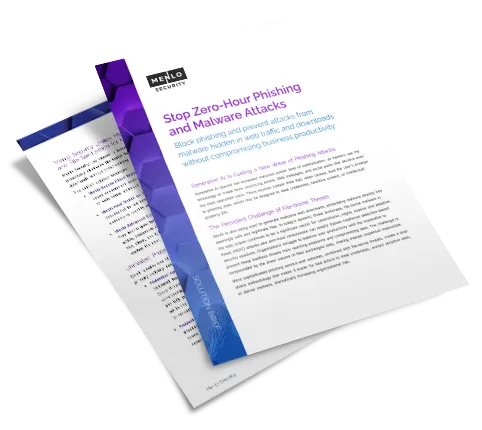
This solution brief covers the solution of Menlo Cloud unified with Next-gen Content Disarm and Reconstruction (CDR)

More now than ever, files are flowing everywhere. Cross-department collaboration. Third-party communication. The ingestion of customer documents. Email attachments. M&A activities. Everyday downloads from the web. And the list goes on and on. Yet, with every file comes risk of malware and ransomware. We know it, you know it, and threat actors certainly know it. To keep all your files safe (and in turn, your enterprise), Menlo File Security works across multiple channels in real-time to protect the very files you depend on. To keep all your files safe (and in turn, your enterprise), Menlo File Security works across multiple channels.
Also known as Content Disarm and Reconstruction (CDR), our patented, AI-trained technology ensures every file is disarmed and rebuilt before it ever reaches enterprise endpoints—no matter where it's coming from, how many times it's been accepted, or whether it's been deemed “safe” by other tools, such as antivirus. That's zero trust for zero zero-day threats.

As file experts, Menlo sanitizes and rebuilds full functionality for over 220 common and complex file types, including active content like macros, ZIP, archives, and even password-protected files. All done behind the scenes, this ensures that end-users see no loss in fidelity, while our ultra-low latency (typically milliseconds) keeps files flowing between users—including large file types like AutoCAD, RAR, as well as video and audio files.

With Menlo in your tech stack, novel and sophisticated file-borne threats never make it to your ecosystem—not even the ones that have yet to be created. With GenAI and LLMs being adopted by bad actors to outsmart traditional defenses and overwhelm security teams with noise, Menlo's proactive CDR automatically deconstructs and delivers only the known-good content, which means you're not just protected today, but the same tech will protect you well into tomorrow.

Menlo File Security is a suite of threat-prevention tools that work as one to prevent bad actors from compromising active workspaces, such as Teams, OneDrive, Box, SharePoint, web browsers, and email gateways. Using next-gen file sanitization (also known as CDR), hash check, antivirus, and the ability to sandbox, Menlo acts as a single source of truth for multi-channel protection.
Even a zero-second threat is a second too late. By getting in front of potential threats, Menlo is able to stop the risk of hidden malware and zero-days before they can reach vital ecosystems, such as data lakes, user devices, and email inboxes. And unlike other so-called solutions on the market, our patented Positive Selection® technology doesn't just sanitize/block and send back PDFs.
Trained on years of AI to detect and mitigate file-borne threats, Menlo File Security is able to dissect, analyze, sanitize, and reconstruct hundreds of files without losing a shred of functionality. Which means, employees can work as normal, security can focus elsewhere, and CISOs can sleep happy.

Long gone are the days of lengthy quarantines and sandboxing. After all, when "time is money," enterprises can't afford to wait as security looks into each file being ingested or uploaded into various endpoints. Whether it's a bank accepting loan applications, a port handling shipping manifests, or an insurance provider processing a dozen claims, Menlo File Security has the experience to facilitate each file exchange in just seconds, typically milliseconds—large, complex, and otherwise.
CAD files? No problem. ZIP? We got it. 2GB Archives? We've got that covered, too. Files requiring password-protection? We sanitize, rebuild, and deliver it back with password-protection intact.

Stopping threats cold turkey is great, but using them to increase your security posture is even better. At Menlo, we want users to get the most out of our solution, which is why Menlo File Security doesn't just prevent malware, but delivers in-depth analytics to ensure security teams are better prepared for any evolving threats coming their way.
We provide a rich analytics dashboard that allows you to inspect each file event and get detailed insights into the behavior surrounding your environment, including commonly-compromised file types, targeted users within the enterprise, vulnerable entry points, and a RetroScan feature that showcases all instances of Menlo working to prevent what would have been successful attacks. This is all done in real-time to help prove ROI while informing the future of your security processes.

While six is just a number fit for a webpage, our file sanitization capabilities go where your users are. From SaaS apps to custom connectors to an open-API that fits within established infrastructures, Menlo File Security keeps you safe while freeing you to do business as usual. Zero breaches is just the icing on top.

Collaboration tools, just like files, are the lifeblood of modern workspaces, connecting internal divisions and third-party vendors in an effort to speed up productivity and enable results.
In order to keep business going, employees must quickly access and download these files – no longer waiting for overburdened IT teams to quarantine, inspect, and release them. Additionally, threats like malware and ransomware cannot always be detected by traditional detection-based safeguards like AV, EDR, and DLP alone.
Menlo File Security is a time-tested solution that keeps collaboration software like Teams, OneDrive, Box, Google Drive (and many others) safe from hidden, file-borne threats while business is happening. It's seamless, fast, and active threat prevention for business as it's happening.


Whenever employees download a file from the internet, they open businesses up to cyber attacks that can compromise private data and lead to costly ransomware. The same goes for any third-parties using shared networks. And while the browser session itself may be protected, any files leaving this ecosystem can still contain zero-day threats. That's why Menlo File Security goes beyond the browser.
Today, even next-gen antivirus (NGAV) can’t keep up with new threats, while sandboxes aren’t protecting enterprises from even the most basic intrusions. Menlo File Security creates a safer web browsing experience with a Zero Trust approach to downloads.
This happens near-instantaneously so that users never experience latency or experience inconvenience while browsing.
As an essential part of the workplace, employees use email without thinking twice about the hidden threats that can make their way in. Hackers exploit this by targeting employees with malicious elements hidden within URLs and attachments when they least suspect it.
Current solutions like antivirus are not able to keep up with advanced threats and zero-day exploits, leaving enterprises with large gaps that can compromise entire networks.
With Menlo’s deep understanding in file composition and weaponization, our Zero Trust approach to file security extends seamlessly to that of the email ecosystem. To protect emails, we break each one down to its base components, separating text, urls, images, attachments, and everything in between. We then build a new email using only the elements found to be 100% secure-including those in attachments-while anything unknown or potentially malicious is left behind.
Banks, insurance agencies, and many financial service providers use upload portals to accept a wide variety of sensitive files and documents uploaded by clients, partners, and the public. In order to keep business moving freely, organizations need to be able to quickly ingest these files without interruption.
Unfortunately, threat actors know that enterprises are processing hundreds, if not thousands of files per day, and that security teams can’t possibly check each one for hidden threats. Meanwhile, antivirus solutions slow down productivity and only recognize known threats, while blocking and quarantining is unacceptable for institutions that rely on speed.
With Menlo, all uploaded files are cleansed of threats before they ever reach cloud applications and storage, ensuring every file that comes through is safe to open and share. Most importantly, functionality is maintained. Macros and password-protection continue to work, and teams are never left with glorified PDFs.
A compromised file transfer can open the door to endless headaches and repercussions for any business – including private data leaks and ransomware that can cost millions of dollars. That’s why it’s imperative that all digital transfers are free of malicious elements and prying eyes. Yet, detection-based solutions can’t prevent unknown threats hiding in your data storage.
As with all our security solutions, Menlo adopts a Zero Trust approach to file transfers – no matter where the files come from. To ensure your file transfers are safe and sound, our patented Positive Selection® technology sanitizes every file before it hits the FTP, FTPS, SFTP, SMB, and/or local folders.
Data lakes become more valuable the more integrated they are, but they also become more susceptible to risk of cyberattacks. So, while team members may inherently trust the files being added to digital storage locations, what happens when third parties start uploading their own? Malicious actors can upload file-borne threats to data lakes that can infect the entire ecosystem – sometimes remaining hidden for long periods of time until traditional security solutions like AV finally recognize them.
Menlo automatically prevents known and unknown threats from poisoning digital storage locations – without ever slowing down business.
Answers to the burning questions in your mind.

Yes! Menlo Security provides advanced Content Disarm and Reconstruction (CDR) capabilities to keep every file in an enterprise’s S3 environment safe and compliant. Files uploaded to S3 buckets are automatically analyzed to remove malware, malicious code, and active content. Deployment is fully automated through AWS Quick Launch, with no manual setup or maintenance required. Head to the AWS Marketplace to learn more.
Unlike detection-based solutions like standalone AV, EDR, and DLPs that scan for suspicious elements and block and/or flatten some malicious files and miss others, Menlo’s technology automatically rebuilds every single file to deliver 100% safe content without the need to detect malicious elements—no blocking, just proactive prevention.
Email: Completely secure every email attachment and suspicious URL.
Web Applications: Sanitize uploaded files via web portal.
Web Browser: In just milliseconds, user downloads are disarmed and rebuilt.
Collaboration Tools: User-to-user file sharing is made secure in real-time.
Content Disarm and Reconstruction happens in real-time, in just milliseconds, leaving the experience completely transparent to end-users. This includes an initial AV scan and hash checking that is near-instantaneous within the CDR process. For sandboxing, the process is as short or as long as the security team deems necessary.
No. Menlo File Security is agentless and integrated via open API depending on the use case. In cases where organizations require on-prem installation, Menlo can accommodate.
As an established browser-agnostic security solution, Menlo natively protects customers from malicious web downloads that move beyond the browser.
Absolutely. Our in-depth threat analytics provide teams with the following:
File type and origin – whether the threat came from an email attachment, browser download, API, or cloud collaboration tool.
Type of malicious content removed – including macros, scripts, exploits, and ransomware payloads.
Hashes, file names, and behavioral indicators – identifiers that trace how similar threats evolve or spread.
Recurring campaigns and targeted users – highlighting which departments, users, or workflows are being probed most frequently.
Menlo can sanitize and rebuild over 220 different file types. This includes complex ones like ZIP, archives, and password-protected files.
For a full list, head here.
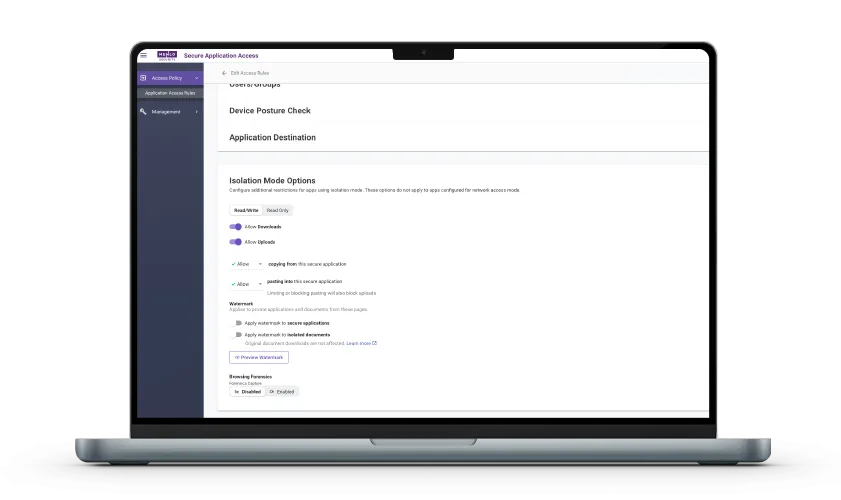
Take a self-guided tour to observe some of the ways that Menlo products enable secure app access, block sophisticated attacks, and provide critical insight into browsing sessions.
See exactly how Menlo can be tailored to solve your unique security challenges. We offer a live demo customized to your teamʼs goals, showing you how to secure your stack and protect your users. A truly secure browsing experience is one click away.


Discover why organizations around the world rely on Menlo Security to protect the enterprise and enable secure access to applications, preventing attacks that legacy security tools cannot stop.
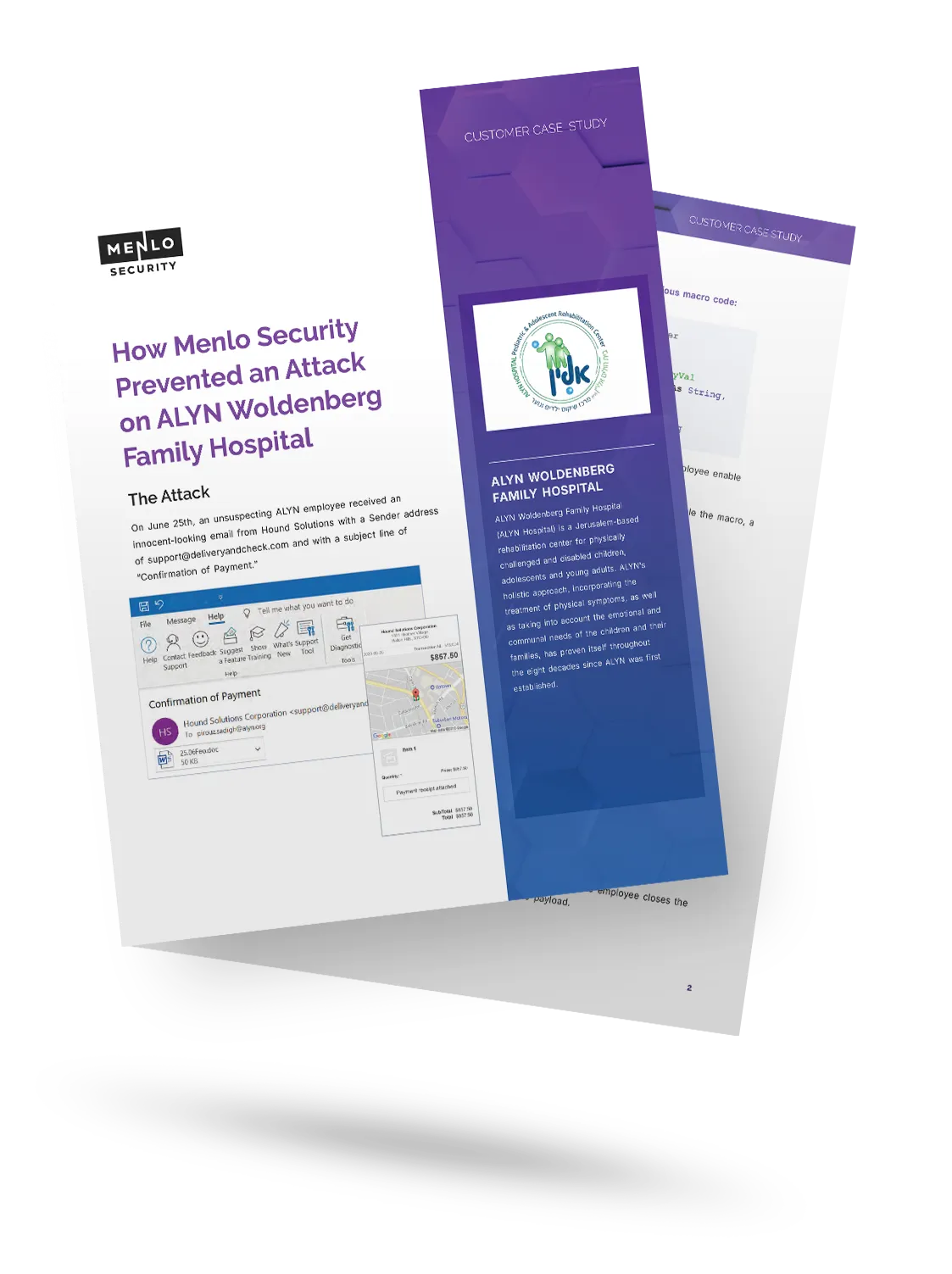
Jerusalem's ALYN Hospital , a pediatric rehabilitation center, was targeted by a sophisticated phishing email containing a weaponized Word document. The attack used malicious macros and evasion techniques to bypass traditional detection. By using Positive Selection technology , the malicious macro was automatically stripped from the file before the employee opened it, instantly neutralizing the threat. This provided 100% protection and gave the hospital the flexibility to safely download files, a capability their previous vendor, which blocked 70% of desired files, could not offer.
"Menlo was easy to roll out and integrates well with our security and technology stack in the cloud.”

“To employees, Menlo is completely transparent, allowing users to navigate a completely functional web resource.”

“…allows Synapxe to protect its assets from malicious threats without impacting the native user experience.“

“I wanted a layered approach that would protect users from web-based threats without slowing down their ability to get work done.”

“The platform has decreased our remediation needs, while reducing patch pressure.”

“Menlo Security helped us eliminate the possibility of a malware infection, rather than just detecting and removing an infection.”
“Before, we had to manually examine every single potential malware problem. Now, my job is much easier…with the Menlo Secure Cloud Browser.”
“Menlo takes care of all the unknown risks running rampant around the internet.”
“Zero-client,easy scaling, and cloud provisioned versus appliance.”
“Menlo Secure Cloud Browser provided the scalability to ensure that users world wide have the same transparent experience and unyielding protection.”
“[Menlo has] eliminated the need to manually apply and update policies across an increasingly distributed IT infrastructure.”
“Menlo provides protection from email-based malware embedded in links and attachments without impacting the user’s native email experience.”
The clientless, cloud-native path to retiring your vulnerable VPN.
VPN Replacement

Deliver zero-trust through standard browsers with zero infrastructure changes, removing the high cost and complexity of legacy ZTNA.
Zero Trust Access
Eliminate the cost, complexity and performance issues of VDI with a streamlined, cloud delivered solution that secures access for alll users and devices with no infrastructure overhaul
VDI Reduction
Enable agentless secure access to SaaS and private apps for unmanaged devices while ensuring compromised endpoints never reach your apps, files, or data
BYOD Security
Go beyond traditional signatures-based detection and protect against unknown phishing attacks targeting the browser with real-time, AI-powered threat prevention.
Phishing Prevention
Stop polymorphic ransomware in the cloud before it ever reaches your devices or penetrates your network perimeter.
Evasive Ransomware
Gain unprecedented visibility into browser sessions for fast incident resolution, threat hunting, audit/compliance, and more.
Browsing Visibility
Enable safe access to generative AI platforms while protecting enterprise data and intellectual property.
Generative AI Governance
Stop file-borne threats that go beyond the browser, including web downloads, portal uploads, and email attachments.
File Security
Use zero trust security to isolate your people and data from threats while providing fast, secure access to apps.
Government Agency Security
All that you expect from SSE with lower cost and complexity, plus browser security.
Browser SSE
Take a self-guided tour to see how Menlo blocks attacks, secures apps, and provides browsing insight.
Product Demos and Tours