Email has long been a primary entry point for cyberattacks, and that isn’t changing any time soon. This is why security teams have invested heavily in defenses, and today’s secure email gateways (SEGs) and filtering tools are far more sophisticated at blocking spam, mass phishing campaigns, and known malicious senders than they were a decade ago. For many organizations, these tools provide a reassuring first line of defense. And here comes the “but.”
Even the strongest filters can’t catch everything. Attackers know that employees trust email as a primary channel for quick and efficient business communication, and they exploit that trust by embedding threats where defenses are weakest: inside the files we open every day. Word documents, PDFs, spreadsheets, and even compressed or password-protected attachments can all serve as delivery vehicles for malware. These file-borne threats slip past traditional filters because they don’t always look suspicious on the surface. The attachment appears to be just another invoice, report, or presentation to the recipient. Hidden within, however, may be code designed to compromise systems the moment it’s opened.
This blind spot, malicious content lurking in otherwise legitimate email attachments, is one of the most persistent and dangerous gaps in email security today.
The challenge in keeping email communication secure is compounded by how quickly the threat landscape has evolved in just the last couple of years alone. Once riddled with typos and easy-to-spot red flags, phishing has become far more convincing thanks to the rise of AI-generated emails. Using AI, attackers can craft messages that mimic corporate tone, formatting, and even individual writing styles—delivering messages that are nearly indistinguishable from legitimate communication and making it easier than ever to trick employees into opening an attachment or clicking a link. Even worse, the speed of AI has enabled these phishing attempts to be recreated and duplicated exponentially faster than ever before. And in the world of malware, it’s a numbers game, and the numbers are winning.
Traditional detection-based tools, such as antivirus, signature scanning, and many advanced filtering solutions, struggle to keep up. They are built to recognize known threats, but attackers increasingly rely on zero-day exploits and polymorphic malware that mutate faster than signatures can be written. By the time a threat is identified, it may have already bypassed defenses and begun spreading. Organizations are left exposed to sophisticated file-borne attacks that slip past legacy security measures. With AI just in the midst of its heyday, these threats are only bound to become more sophisticated and harder to discern from legitimate files.
Despite the progress in email defenses, the tools most organizations rely on were never built to handle today’s file-borne threats. SEGs, for example, are highly effective at filtering spam and blocking obvious phishing attempts. They’re excellent at stopping what looks bad from the outside. But they weren’t designed to dissect and sanitize files, which means malicious content embedded in an otherwise legitimate document often slips right through.
Some organizations layer in sandboxes to add another level of inspection. While this approach can catch certain kinds of malware, it comes at a cost. Sandboxes are slow and resource-intensive, creating delays that frustrate end users. Worse, attackers have learned to outsmart them. Malware can be coded to recognize a sandbox environment and stay dormant until it’s safely inside the production network, bypassing the very protection meant to stop it.
Even when threats are eventually identified, it’s often too late. Endpoint Detection and Response (EDR) and traditional antivirus tools kick in only after an attack is underway. By then, the malware may have already executed, exfiltrated sensitive data, or moved laterally across systems. At that point, security teams are left reacting to an incident rather than preventing it.
The result is a dangerous gap: traditional defenses do a good job of clearing away the obvious clutter but consistently miss the stealthy, file-borne attacks that cause the most damage. This leads to the all-too-familiar zero-hour and zero-day breach headlines that pop up as often as a luxury car wash in a small town. That’s to say, more often than is necessary.
Closing this gap requires a different approach that doesn’t rely on spotting the bad, but instead making sure users only interact with what’s safe.
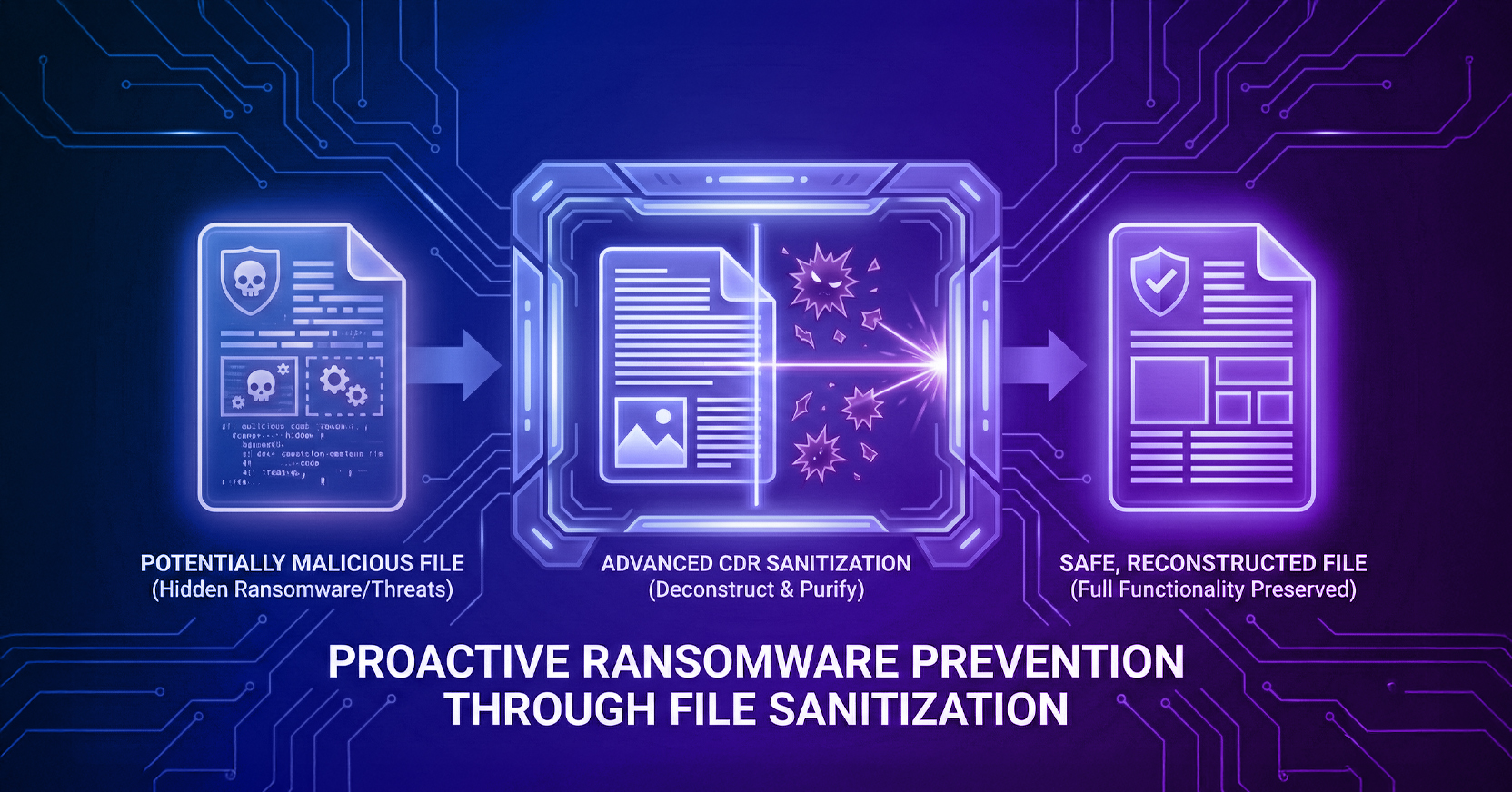
Menlo’s next-gen Content Disarm and Reconstruction (CDR) ensures every email attachment is sanitized in real time. Menlo integrates directly with mail servers (and the O365 API) to deliver seamless protection. Rather than blocking or quarantining files, Menlo rebuilds each document on a clean template, transferring only the verified safe elements. Employees receive fully functional, clean files in milliseconds without disrupting their workflow.
Embracing a Zero Trust philosophy is also key to closing this gap. Zero Trust ensures that every file, every link, and every download is treated as risky until proven (or made) safe. By default, nothing gets through unexamined.
For security leaders and IT teams, the value of this approach is clear. With proactive protection, file-borne threats are neutralized before they ever reach the endpoint, stopping compromises at the source rather than reacting after the fact. By removing the need for quarantining, manual file reviews, and endless alert triage, organizations also avoid the alert fatigue that drags down SOC efficiency.
The message is simple: email security isn’t complete without file sanitization. Threats don’t need to be detected if they never reach the inbox in the first place.
Menlo Security