Menlo Closes the Loop on Zero-Day and AI Agent Attacks with New Google Security Operations Integration
Details


.svg)
The high infrastructure demands of desktop virtualization (VDI and DaaS) were not built for today's dynamic hybrid environment. This rigid architecture introduces immense capital expenditure and specialized labor, while chronic latency frustrates users. Ultimately, scaling VDI to meet growing demand becomes prohibitively expensive and architecturally unsustainable. Additionally, many organizations are forced to maintain expensive, complex VDI used to provide access to a few 'thick-client' apps.
The architectural burden and excessive cost of VDI are no longer sustainable for securing managed and unmanaged devices. The enterprise needs a solution that drastically cuts infrastructure costs, simplifies IT management, and delivers superior performance without the complexity of desktop virtualization.
A combined 71% of organizations require VDI specialist intervention at least weekly. This includes 31% who report daily problems and an additional 40% who report them weekly.
Nexthink Research.
When users report VDI issues to IT, nearly half (47%) of all complaints are related to slow performance. This makes it one of the most common and disruptive problems in VDI environments.
Betanews.
Beyond just running slow, the single most-reported VDI problem is application functionality failures, which are cited as the top complaint by 54% of organizations.
Nexthink Research.
Menlo SAA is the ultimate VDI replacement. It provides secure access to any application, including delivering legacy apps as secure browser tabs, delivering a 'VDI-less' experience.
Eliminating the need for VDI's host-based isolation, SAA establishes a protective barrier in the cloud, guaranteeing no application code, session data, or sensitive files ever execute on the end-user device. This completely removes the endpoint as a threat vector, ensuring VDI-level security without complex management or agent deployment.

SAA provides a seamless, faster user experience than traditional virtual desktops. By delivering applications directly through a standard browser, SAA eliminates the latency, performance bottlenecks, and backhauling issues common in VDI. Users get instant, reliable access to their needed applications without complex client software or frustrating lag.

SAA bypasses network bottlenecks and hair-pinning to deliver highly available application speeds for every user, anywhere.
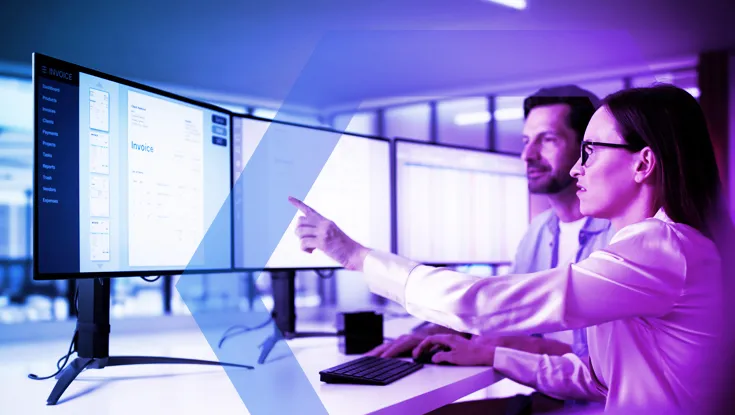
Modern secure access requires eliminating the high costs, complexity, and performance issues of legacy VDI. VDI leads to a high total cost of ownership due to expensive and multiple licensing costs, hardware costs, extensive operational costs, and future scaling costs. Menlo SAA removes these inefficiencies by providing a streamlined, cloud-delivered, zero trust solution that secures access for every user and device without requiring any complex infrastructure overhaul, leading to a lower total cost of ownership.
Menlo SAA directly replaces the need for expensive VDI infrastructure, licensing, and maintenance. Menlo delivers superior security without the complex management or agent deployment of VDI, which significantly lowers your total cost of ownership (TCO). This allows IT and security teams to redirect budget and manpower away from maintaining complex virtual environments and toward strategic projects. Menlo SAA shifts your architecture from broad network-level access to precise application-level access. This eliminates attack surface, and guarantees that users only get access to what is necessary. This is the only way to prevent lateral movement and achieve true zero trust security.

Menlo SAA ensures no application code or session data ever executes on the endpoint. This protective barrier removes the risk of malware and lateral movement, which is critical because it allows your organization to retire expensive, complex VDI infrastructure while maintaining the highest level of data and application isolation for your entire workforce. All this protection is delivered without the need of an agent.

Menlo SAA completely transforms the user experience by delivering a seamless, easy, and high-performance application experience. It eliminates the constant lag and frustrating bottlenecks inherent in VDI. By delivering a native experience directly through the user's browser, it removes the operational friction and complexity that hamper productivity, ensuring your entire workforce gets instant, reliable access to any application without the constant IT support calls common with VDI.

The seamless experience, superior security, and dramatic cost savings you can achieve are direct results of a fundamental shift away from network-centric, legacy approaches like VDI. Below are the key capabilities that enable Menlo SAA to deliver agentless, zero trust access without the complexity of virtualization.

Menlo SAA provides secure access through a standard browser (or extension) with no need to install, configure, or manage an endpoint agent or a thick client. VDI requires installing and managing client software on every access device. Every session runs entirely within the Menlo Cloud, guaranteeing that no application code or data ever reaches the endpoint. Additionally, Menlo’s zero-trust access is extended to legacy thick-client applications, allowing organizations to move away from the complexity of VDI and VPNs in favor of a streamlined, browser-first strategy.


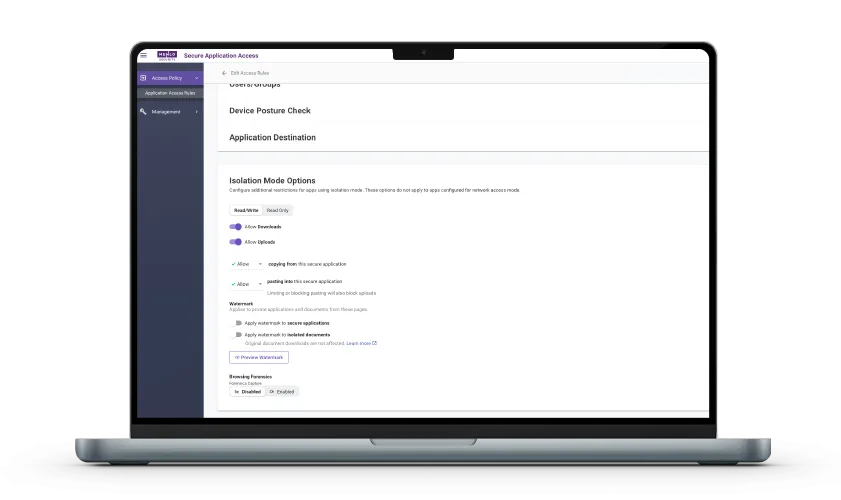
Menlo SAA extends advanced data protection to any application, including legacy thick-client apps that traditional security tools can't reach. By moving the session to the Menlo Cloud, you gain granular, in-session control, such as blocking copy/paste, restricting uploads/downloads, and watermarking.
Users can also access and view files within the secure Menlo Cloud environment instead of on a potentially compromised endpoint. Unlike traditional VDI, which offers little to no control over data exfiltration once a session is established, Menlo ensures that data remains governed at all times. Furthermore, Menlo File Security proactively scrubs malicious content before it can reach application servers, providing a level of "zero-trust" security—including in legacy environments—that was previously unattainable.
Menlo SAA with Browsing Forensics can provide complete, auditable logging and forensics of all user actions within the browser session, including keyboard and screen capture. This gives security teams deep visibility that is often limited or missing in VDI environments.
Menlo SAA enforces true zero trust principles by validating the real-time security health of every device before and during a session. Our dynamic posture check verifies essential factors like OS patch levels, firewall status, and disk encryption. If a device fails, access is instantly restricted or limited, ensuring that your corporate applications are never accessed by a compromised or non-compliant endpoint. Furthermore, seamless integration with Google Chrome Enterprise enables granular posture checks without requiring users to install any additional software, which is especially helpful for managed devices, BYOD users, and contractors using their own devices.
This capability moves beyond simple network access to enforce highly detailed policies based on user identity, group, geolocation, or source IP. This ensures every user is granted the absolute minimum "per-request" access, preventing the broad network access of legacy systems. Additionally, you can apply data security controls, including watermarking, upload/download limits, and copy/paste restrictions, to protect sensitive data, even on unmanaged endpoints.
Answers to the burning questions in your mind.

SAA supports the following application categories:
Modern Web Applications and SaaS: It provides secure, agentless access to applications like Microsoft 365, Salesforce, Workday, and other cloud-hosted solutions.
Internal Private Web Applications: SAA can secure access to corporate web-based resources hosted in a private data center or private cloud environments (AWS, Azure, GCP).
Legacy and Non-Web Applications: SAA also supports legacy applications via the Menlo Security Client. Via our Google Cameyo integration, Menlo supports legacy Windows 'thick-client' applications, all delivered agentlessly through any standard browser.
SAA is a cloud-native service based on a simple, predictable per-user license. It eliminates the Capital Expenditure (CapEx) and continuous Operational Expenditure (OpEx) of VDI infrastructure, including servers, storage, desktop image management, and ticket support, resulting in 5x to 10x lower Total Cost of Ownership (TCO).
Yes. VDI streams an entire desktop display over the network, which often leads to latency and poor performance, especially for video and remote workers. SAA delivers a faster, native user experience because it avoids this video-streaming overhead by routing only secure application content to the user's local browser.
Yes, for the vast majority of users. With the addition of Cameyo, Menlo SAA now supports legacy Windows applications that previously required VDI. Organizations can now move to a 100% browser-first strategy for almost all corporate work.
Organizations are displacing VDI by replacing VDI instances with Menlo Secure Application Access for web-based applications. VDI is often costly and complex, and its protocols are inefficient for the higher-latency environments of remote work compared to HTTP/S and HTML. Menlo delivers a secure, enhanced user experience with significantly reduced costs by providing clientless, zero trust access via the Menlo Cloud to private and SaaS applications.
Take a self-guided tour to observe some of the ways that Menlo products enable secure app access, block sophisticated attacks, and provide critical insight into browsing sessions.
See exactly how Menlo can be tailored to solve your unique security challenges. We offer a live demo customized to your teamʼs goals, showing you how to secure your stack and protect your users. A truly secure browsing experience is one click away.


Discover why organizations around the world rely on Menlo Security to protect the enterprise and enable secure access to applications, preventing attacks that legacy security tools cannot stop.
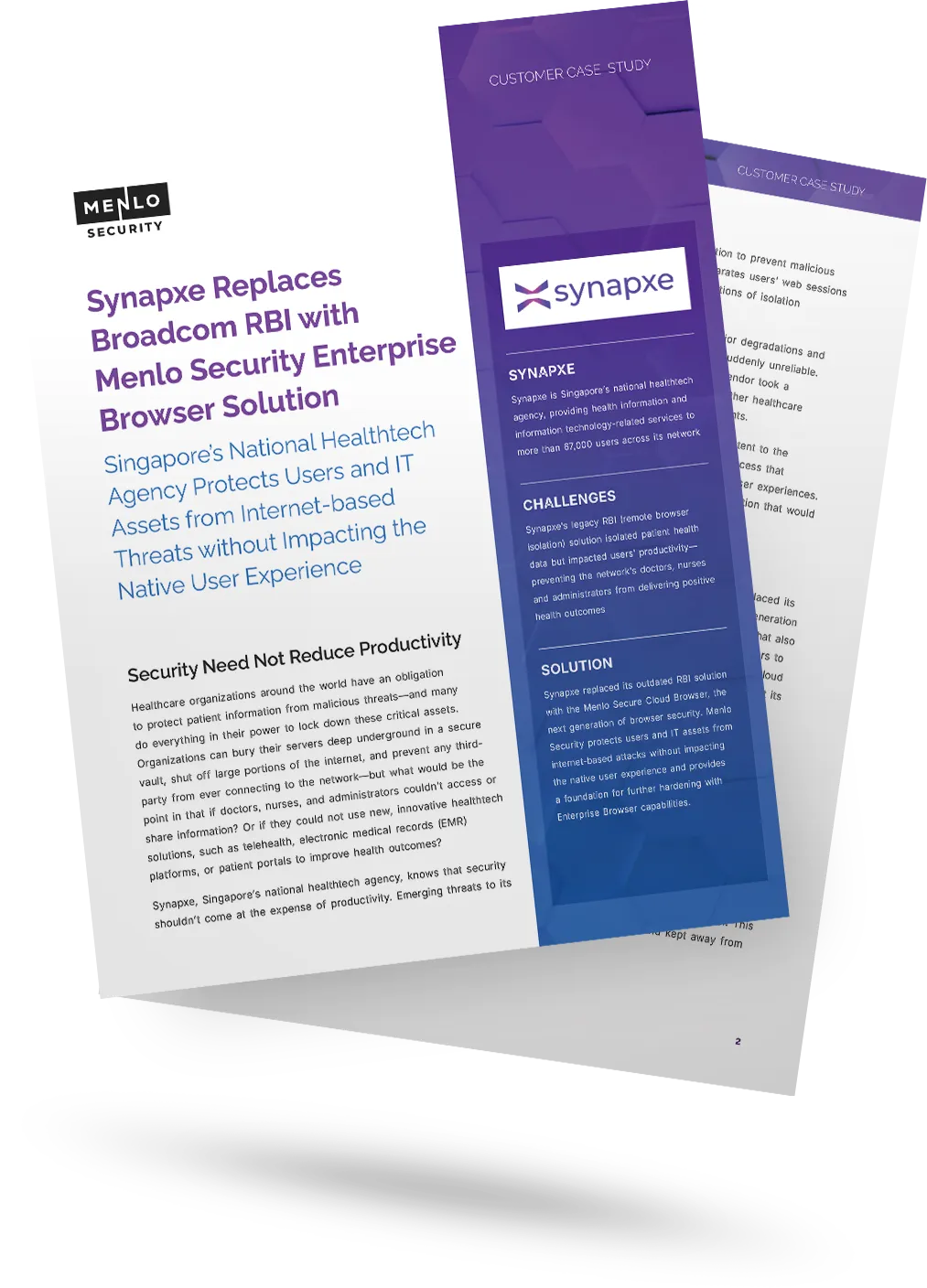
To protect its 67,000+ users, Singapore’s healthtech agency Synapxe replaced its disruptive, pixel-streaming RBI solution. They adopted the Menlo Security Enterprise Browser, which uses Adaptive Clientless Rendering™ (ACR) and DOM mirroring to deliver a lightweight, safe view of websites. This provided seamless security without the performance degradation of their previous solution.
"Menlo was easy to roll out and integrates well with our security and technology stack in the cloud.”
“To employees, Menlo is completely transparent, allowing users to navigate a completely functional web resource.”

“…allows Synapxe to protect its assets from malicious threats without impacting the native user experience.“

“I wanted a layered approach that would protect users from web-based threats without slowing down their ability to get work done.”

“The platform has decreased our remediation needs, while reducing patch pressure.”

“Menlo Security helped us eliminate the possibility of a malware infection, rather than just detecting and removing an infection.”
“Before, we had to manually examine every single potential malware problem. Now, my job is much easier…with the Menlo Secure Cloud Browser.”
“Menlo takes care of all the unknown risks running rampant around the internet.”
“Zero-client,easy scaling, and cloud provisioned versus appliance.”
“Menlo Secure Cloud Browser provided the scalability to ensure that users world wide have the same transparent experience and unyielding protection.”
“[Menlo has] eliminated the need to manually apply and update policies across an increasingly distributed IT infrastructure.”
“Menlo provides protection from email-based malware embedded in links and attachments without impacting the user’s native email experience.”
The clientless, cloud-native path to retiring your vulnerable VPN.
VPN Replacement

Deliver zero-trust through standard browsers with zero infrastructure changes, removing the high cost and complexity of legacy ZTNA.
Zero Trust Access
Eliminate the cost, complexity and performance issues of VDI with a streamlined, cloud delivered solution that secures access for alll users and devices with no infrastructure overhaul
VDI Reduction
Enable agentless secure access to SaaS and private apps for unmanaged devices while ensuring compromised endpoints never reach your apps, files, or data
BYOD Security
Go beyond traditional signatures-based detection and protect against unknown phishing attacks targeting the browser with real-time, AI-powered threat prevention.
Phishing Prevention
Stop polymorphic ransomware in the cloud before it ever reaches your devices or penetrates your network perimeter.
Evasive Ransomware
Gain unprecedented visibility into browser sessions for fast incident resolution, threat hunting, audit/compliance, and more.
Browsing Visibility
Enable safe access to generative AI platforms while protecting enterprise data and intellectual property.
Generative AI Governance
Stop file-borne threats that go beyond the browser, including web downloads, portal uploads, and email attachments.
File Security
Use zero trust security to isolate your people and data from threats while providing fast, secure access to apps.
Government Agency Security
All that you expect from SSE with lower cost and complexity, plus browser security.
Browser SSE
Take a self-guided tour to see how Menlo blocks attacks, secures apps, and provides browsing insight.
Product Demos and Tours